Sunday, December 14, 2025

Vermont Entomology Academy: Inspiring Curiosity Through Insects and Nature Education

Discover the Vermont Entomology Academy, inspiring curiosity and connection through insect observation and hands-on learning.


V.E.A., founded by Bernie Paquette in 2025, connects people with nature through the fascinating world of insects. From summer bug observations to mobile outreach, the Academy helps learners of all ages discover the joy and importance of insects in our ecosystems.


🪲 Vermont Entomology Academy

Welcome to the Vermont Entomology Academy — where curiosity takes flight!

Explore our current and developing programs below.

VEA: Curious  Connected  Alive


🌿 Mission = why we exist

To spark curiosity, build confidence, and strengthen connections to nature through insect-focused observation and learning.

To promote the value of community-science observations for conservation and for monitoring ecosystem health.

To express an identity that is fun, exploratory, and grounded in the natural world.


🧭 Goals = what we want to achieve

  • Inspire curiosity, confidence, and connection with the overlooked creatures that keep ecosystems thriving.

  • Promote “inverting” — the joy of observing and learning about invertebrates, especially insects.

  • Encourage community-science participation so more people contribute meaningful insect observations.

  • Foster a culture of wonder that motivates people of all ages to explore, notice, and care for the natural world.


  • 🔍 Objectives = what participants will learn/do

    Through Academy programs, participants will:

    • Understand the vital roles insects play in ecosystems and in human life.

    • Explore ecosystem connections — the physical and functional relationships that support biodiversity and resilience.  

    • Learn the fundamentals of entomology: anatomy, diversity, life cycles, and lifestyles.

    • Experience the joy of observing insects in their natural habitats. 

    • Use iNaturalist to document, identify, and share observations (and become familiar with other entomological resources, including museum collections).

    • Practice using essential field tools — nets, magnifiers, and guidebooks — to investigate insects up close.

    • Develop keen observation and identification skills, deepening appreciation for nature’s details.

    • Cultivate a sense of awe for the small, complex, interconnected beauty of the insect world.

    • Recognize insects as living beings with needs: finding food, seeking shelter, avoiding danger, and striving to thrive as individuals and species.

    You don’t need to know the science of insects to be amazed by them —
    But learning a little makes the wonder grow even more.

    _________________________________________

    🐞 Vermont Entomology Academy Programs


    Bug Huggers Adventure Camp

    📍 Saint Michael’s College | Department of Biology
    “Bugs, Nets & Sunshine: Vermont Entomology Academy Day Camp 2026”
    Hands-on learning, outdoor exploration, and guided insect adventures await!


    🚐 BUGmobile

    mobile natural history collection operation designed to bring lessons on insects to communities across Vermont.
    Currently in the planning stage, the BUGmobile will deliver interactive insect learning experiences to schools, libraries, and community events statewide.

    We are seeking donations of the following: 
    Microscope
    Field guides
    Insect Nets
    Hand lens: magnifiers (multiple)
    Insect capture vacuum tools 
    Entomology forceps
    Pinning block
    Entomology pins in various widths and sizes
    Pinning display box 
    Pinned insects, including trays of specimens
    Identification keys 
                                                                   Collection jars, vials.                                                                
    A pool of members who volunteer to offer at least one hour-long, interactive insect presentation in a year. No fixed schedule—just a willingness to share what you love. 


    🦋 Bug & Bird Safari

    📍 Underhill Conservation Commission | Vermont Entomology Academy
    June & September — Free (Registration through U.C.C.)
    Join naturalists for guided outdoor safaris to discover insects and birds in their natural habitats.


    🐜 Bug Safari | At Your Yard

    📅 June through August
    🕒 Flexible scheduling (1–2 hours)
    💲 Free
    "Have you ever wondered what pollinators are visiting your garden or what that black-and-yellow striped bug was?"Invite the Vermont Entomology Academy to your own backyard for a personalized insect exploration experience!


    💧 Incredible Workshop: “Life Begins in Water”

    Currently in the brainstorming stage, this workshop will explore aquatic insects and their essential role in ecosystems.


    🎪 The Great Vermont Insect Fair

    Another exciting idea in development, this event will celebrate insects with exhibits, demonstrations, and hands-on activities for all ages.


    Presentations

     📅  Locations Community Center in Jericho: February day and time tbd


    When Birds Meet Bugs: How One Yard Became a Wildlife Haven (5-minute Lightning talk)


    Yard Highlights

        Have you ever wondered what is living in your yard? Bernie will show photos and discuss some of his findings from a 1.3-acre Jericho yard, including some uncommon and even a few firsts for Vermont (40 minutes).


    Spencer Hardy (Vermont Center for Eco Studies Biologist and of the Farm Upstream will present highlights from the research paper he helped write:  


     "New Vermont Bee Checklist and Conservation Rankings Published". 


    The study, led by researchers from VCE, in collaboration with the Vermont Fish & Wildlife Department and experts from across the continent, provides the first comprehensive faunal list and conservation assessment of Vermont’s wild bees. A decade-long study published this month found that 352 wild bee species call Vermont home. The bad news is that 60% of those species are likely in need of conservation action. But the good news is that with this study, we've taken a crucial step toward protecting them. (45 minutes).

    ______________________________________________________________

    🦋 Moth Night

    📍 Locations TBD Date: Week of  7/18-7/26, 2026

    In the planning Stage, 

    “Lights, Sheets & Wings: Vermont Entomology Academy Moth Week Celebration 2026”

    Discover the magic of nighttime biodiversity! Join us after dark for moth-watching, light-sheet exploration, and guided observation with Vermont Entomological Academy and Vermont Entomological Society naturalists.
    ______________________________________________________________
    ✨ Firefly Night
    📍 The Farm Upstream, Lee River Road, Jericho, Vt. Date between mid-June and mid-July
    “Glow & Wonder: Vermont Entomology Academy Firefly Discovery Evening 2026”
    Experience the sparkle of summer nights! Learn about firefly communication, watch their bioluminescent displays, and enjoy guided twilight exploration with VEA naturalists.
    ____________________________________________________________

    🌻 Get Involved: Join the Vermont Entomology Academy

    The Vermont Entomology Academy is recruiting!
    We’re looking for passionate individuals who want to help grow our mission of inspiring curiosity and connection through insects.

    We welcome:

    • 🧑‍🎓 College students

    • 👩‍🏫 Educators

    • 🔬 Biologists & Ecologists

    • 🎨 Artists & Naturalists

    • 🌎 And other enthusiastic “ists” who love science, nature, and community engagement!

    We currently have openings for:

    • Board of Directors

    • Steering Committee

    • Planning and Working Groups

    • One-Time Presenters

    • Lab and Field Facilitators

    📩 Interested in joining us?
    Please contact us to learn how you can get involved with the Vermont Entomology Academy.


    Our organization is being built on passion, shared leadership*, and the belief that everyone has something meaningful to contribute. There is a place for you.

    Everyone has the power to shape things. The leader’s role then focuses on facilitating shared decision-making and supporting others. A community leader facilitates people who are there by choice.  Leadership essentially becomes about facilitating co-creation circles and deep listening.

    A hybrid approach between centralized and decentralized leadership may sometimes be needed.

    • Leadership by proposal: The community leader is the group’s main resolver of ambiguity.
    • Leadership by invitation: The community leader’s role is to proactively and personally invite people to contribute.
    • Leadership by role-modeling: The power of a community leader to shape culture and embody a group’s values.


    🌼 Join the Movement - bring to the table whatever you are good at!

    The Vermont Entomology Academy welcomes all curious minds — students, families, educators, and lifelong learners — to explore the fascinating world of insects.

    Because when we pay attention to the small things,
    We begin to understand the big picture of life on Earth.

    Vermont Entomology Academy offers insect learning experiences from your yard to public parks; entomology and invertebrate education for kids in classrooms at schools, libraries, churches, and other meeting places. 


    🕹️ Connections Game Grid: Insect Edition

    Here’s a Connections-style game grid (like The New York Times Connections) using insect anatomy and basic entomology terms. Your task (or your students’ task) is to group the 16 words into four sets of four related terms.
 Each group has a common theme related to insect anatomy or entomology.

    Words:
    Antenna • Mandible • Elytra • Thorax • Larva • Pupa • Nymph • Egg • Chitin • Exoskeleton • Spiracle • Trachea • Proboscis • Ovipositor • Compound Eye • Ocellus


     Spoiler alert - Here is a hint: the correct groups are.

    Group 1 – Body Parts (External Anatomy):

    Group 2 – Developmental Stages:

    Group 3 – Structural / Protective Features:

    Group 4 – Respiration & Reproduction:

    ____________________________________________________________________________________________________

    Reflections on Wonder, Place, and Paying Attention

    “Sometimes You Have to Go Outside and Look.” 
    Erica Fleishman, Ph.D., Oregon State University

    "The greatest human discoveries in the future will be the discovery of human intimacy with all those other modes of being that live with us on this planet…"
    —Thomas Berry, The Great Work

    "If you want to feel new, alive, full of fresh hope, and in love with the world, the place to visit may be your backyard."
    —paraphrased from Pico Iyer, The Art of Stillness

    Teaching a child not to step on a caterpillar is as valuable to the child as it is to the caterpillar.” ~Bradley Miller 

    And from a somewhat unexpected source:

    "If I ever go looking for my heart’s desire again, I won’t look any further than my own backyard. Because if it isn’t there, I never really lost it to begin with."
    —Dorothy, The Wizard of Oz

    The message is the same across science, spirituality, and story:
    Look closely. Look often. Look where you stand.
    You might discover something uncommon.


    VEA Framework for Development 

    • Online courses endorsed by iNaturalist in entomology, taxonomy, and photography
      • Photographers and amateur community scientists on iNaturalist are often interested in refining their skills and expanding their knowledge.
    • Book recommendations and links to external resources and synergistic online portals such as BugGuide.net
    • Enhancing photographic skills for iNaturalist (crop photos, take sharper images, and multiple angles...
    • Broaden and build on iNaturalist advocates, who currently promote iNaturalist, to carry out the vital role in encouraging more taxonomists to enter the community. (extracted from Callaghan et al. 2022). "It is generally accepted that the number of undescribed insect species is at least as large as the number of described species…” (Warburton, P. J., Ascher, et al. 2025)
    • Create a list of Vermont taxa that require identification based on features that photographs are never likely to show. 
    • Recruit and increase insect ID experts.
    • Develop, sponsor, or support projects that focus on areas lacking in observations for taxa in general or for specific taxa. 
      • Also, focus on the wide insect-to-flower interaction (cover as many flowering plants as possible). List Floral Resources to Target
    • Develop a local Community of Practice for iNaturalist use, observation, photo, collection, and other invertebrate study techniques.
      • "A Community of Practice is a working group of a community of stakeholders, based on ideas by Lave and Wegner (1991) about community learning and development. The constituents of a Community of Practice group would be influential or senior representatives of each of the stakeholder communities with an objective to formulate actionable strategies for improving the use of iNaturalist..." ((Warburton, P. J., Ascher, et al. 2025).

    Friday, December 12, 2025

    Thursday, December 11, 2025

    Bee Anatomy Definitions


    Bee Anatomy Definitions

    Category

    Term

    Description

    Main (rear) body part 

    Abdomen

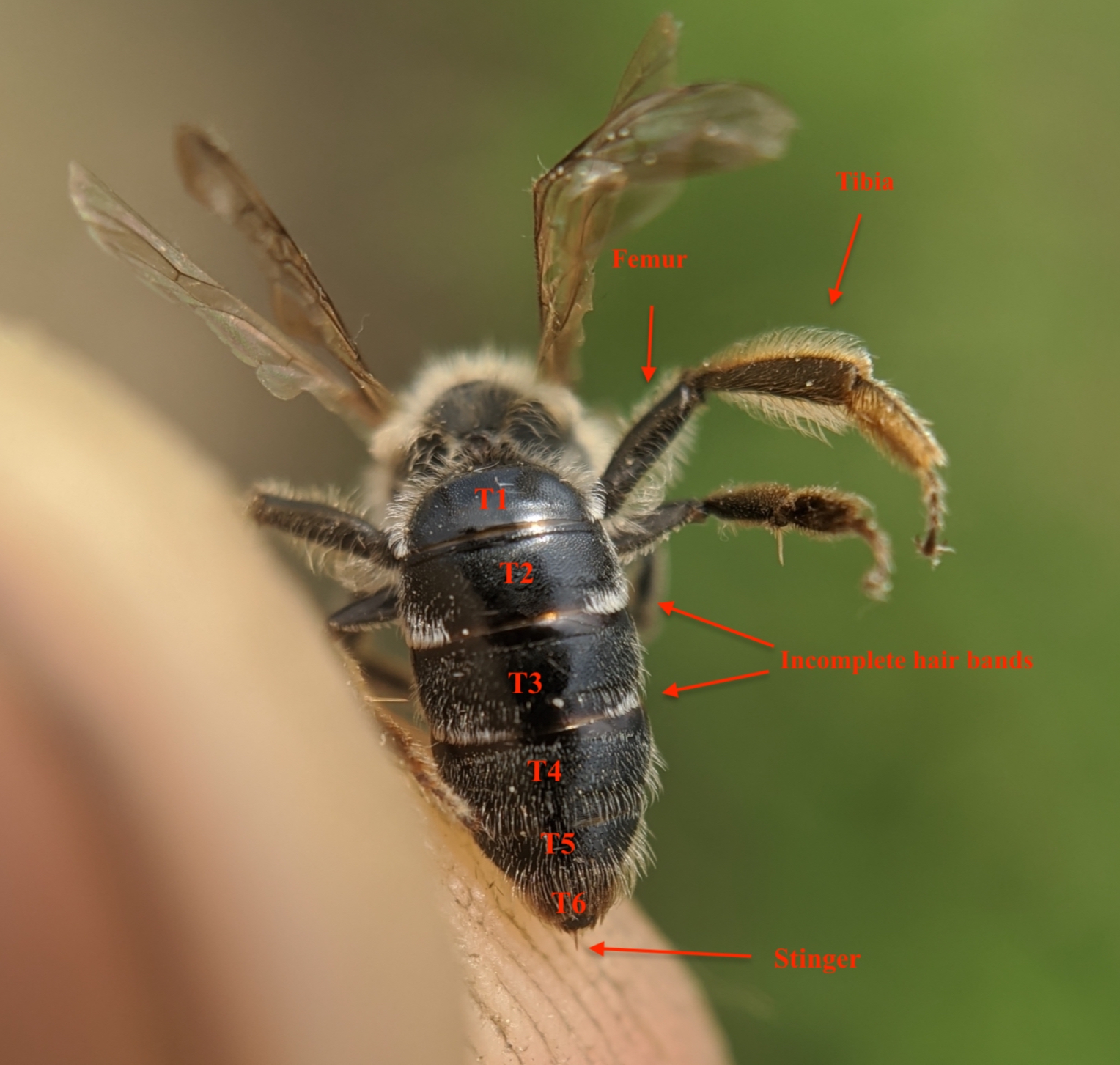
    A bee's abdomen is its rear body section, containing vital organs for digestion (honey stomach), reproduction (spermatheca, ovaries, testes), and defense (stinger), plus glands for wax (wax glands) and scent (Nasonov gland) in workers, all covered in protective segments that allow flexibility and house important functions like nectar storage and even breathing through pulsing. T1 is the first segment of the abdomen after the thorax, then T2, T3, T4, T5, and then T6 is the last portion of the abdomen.

    Important morphology (VCE)

    Abdomen detail

    https://val.vtecostudies.org/wp-content/uploads/2021/02/andrena-annotated.jpeg

    Main body part (respiration)

    Spiracles

    Bee spiracles are tiny, valve-controlled holes along a bee's thorax and abdomen that serve as its respiratory openings, allowing air (oxygen) to enter and carbon dioxide to exit, connecting to a network of internal tubes (tracheae) that deliver gases directly to the bee's cells, bypassing lungs. Bees have ten pairs of these spiracles, which open and close to regulate airflow, keeping moisture in and preventing debris from entering, with abdominal movements pumping air in and out. 

    Main body part (middle)

    Thorax

    The thorax is the middle section of a bee's body, and it is the center for locomotion, meaning it's where the six legs and two pairs of wings are attached. This segment contains powerful muscles that drive flight, produce buzzing sounds, and help the bee move. The thorax is also composed of three smaller segments that each have a pair of spiracles (2), which are openings for air.

    Face

    Antennae

    Sensory appendages for smell, touch, and navigation.

    Face

    Antennal Sockets

    Cavities in which the antennae articulate.

    Face

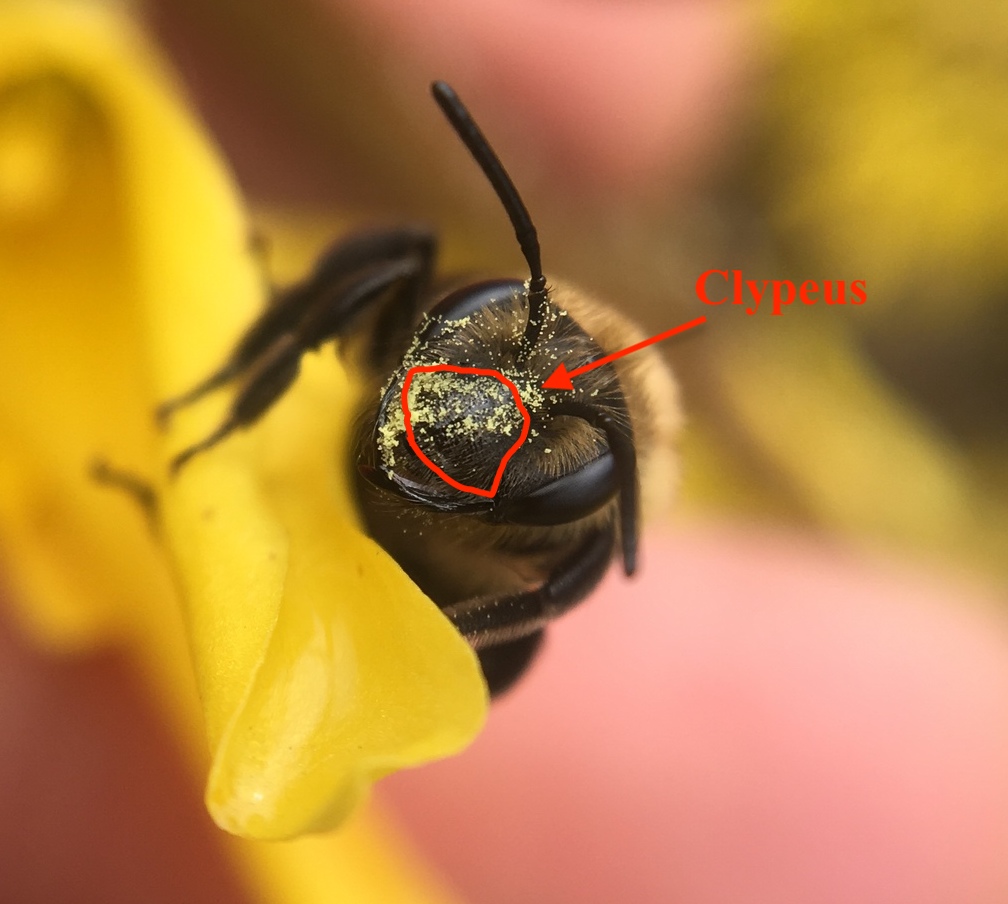
    Clypeus

    Clypeus refers to the plate on the lower part of an arthropod’s face. Broad facial plate between the frons and labrum. Frons: Central face area between the antennae and ocelli. Labrum: Upper lip assisting food manipulation.

    Face

    Compound Eyes

    Large, multi-faceted eyes providing wide-angle vision.

    Important morphology (VCE)

    Face detail

    https://val.vtecostudies.org/wp-content/uploads/2021/02/clypaeus.jpg

    Face

    Frons

    Central face area between the antennae and ocelli.

    Face

    Labrum

    Upper lip assisting food manipulation.

    Face

    Mandibles

    Jaws used for cutting, carrying, and nest construction.

    Face

    Ocelli

    Three simple eyes on top of the head that detect light intensity.

    Face

    Paraocular lobe

    On a bee's face: an area extending along the sides of the head, parallel to the inner margin of the compound eyes. 

    Face

    Tooth, or subapical tooth

    "Tooth" is a spine-like projection on the bees anatomy, typically located on the mandibles (jaws) or the gena (cheek area behind the eye). These are not true teeth like those found in mammals, but rather hardened, chitinous extensions of the exoskeleton that aid in specific functions. A subapical tooth is a small, tooth-like projection located on the mandible (jaw).

    Mouthparts

    Galea

    Sheath-like maxillary element forming part of the tongue.

    Mouthparts

    Glossa (tongue)

    A bee's glossa (Greek for "tongue") is the central, hairy, tube-like structure within its proboscis, acting like a flexible, hairy spoon to lap up nectar, which then gets sucked up the food canal for storage, forming a complex feeding straw. While people often call the whole thing the proboscis, the glossa is just the inner, hairy part that collects liquid, supported by other mouthparts like labial palpi and galeae to create a watertight tube for efficient feeding, making it a "straw-spoon hybrid"

    Mouthparts

    Labial Palps

    Sensory appendages on the labium.

    Mouthparts

    Labium

    A bee's labium is its "lower lip," a key part of its sucking mouthparts (proboscis that, along with other structures, forms a tube to drink nectar, acts like a spoon to lap it up, helps clean the bee and hive, and features sensory palps (16) for taste. It's formed from fused ancestral second maxillae and contains the 'tongue' (glossae and paraglossae) and palps for sensory input, allowing bees to taste as they feed. 

    Mouthparts

    Maxillae

    Lateral mouthparts aiding food manipulation.

    Mouthparts

    Palps

    Bee palps (or palpi) are sensory appendages on a bee's mouthparts, with two pairs—maxillary palps (upper) and labial palps (lower)—that help with sensing food, grooming, and manipulating the proboscis (tongue) for nectar feeding. These jointed feelers detect chemicals and textures, aiding in food selection and taste, acting like tiny sensory antennae near the mouth. 

    Mouthparts

    Paraglossa

    Small lobes flanking the main glossa. Glossa: Tongue

    Mouthparts

    Proboscis / Glossa

    Elongate tongue used for nectar uptake.

    Dorsal

    Mesoscutum

    Large central dorsal (top) thorax plate.

    Dorsal

    Metanotum

    Small plate behind the scutellum. Scutellum: Plate following the mesoscutum.

    Dorsal

    Pronotum

    Narrow segment behind the head.

    Dorsal

    Propodeum

    First abdominal segment fused to thorax.

    Dorsal

    Sclerite

    A sclerite is any of the hardened plates that form the bee's exoskeleton. These rigid, chitinous plates are connected by flexible, soft membranes (arthrodial membranes), which allow the bee to move despite having a hard outer covering. 

    Dorsal

    Scutellum

    Plate following the mesoscutum. (Small section at the base of the Thorax). Mesoscutum: Large central dorsal (top) thorax plate.

    Dorsal

    Tegulae

    Small sclerites above wing bases. (Where the wing attaches to the thorax.)

    Dorsal

    Tergites

    Dorsal (upper or back of the bee) abdominal segments.

    Dorsal

    Vertex

    Top of the head behind the ocelli. Ocelli: Three simple eyes on top of the head that detect light intensity.

    Ventral

    Corbicula Floor

    Surface supporting pollen loads.

    Ventral

    Gena

    Lower side portion of the head.

    Ventral

    Mesepisternum

    Major thoracic side plate.

    Ventral

    Sternites

    Ventral (underside) abdominal segments.

    Ventral

    Ventral Propodeal Plate

    Underside of the propodeum. Propodeum: First abdominal segment fused to the thorax.

    Lateral

    Gena

    Cheek region behind the eyes.

    Lateral

    Mesepisternum

    Large thoracic plate on the side.

    Lateral

    Metepisternum

    Rear side plate of thorax.

    Lateral

    Pre-episternal Groove

    Groove separating thoracic plates.

    Lateral

    Propodeal Spiracle

    Respiratory opening on propodeum. Propodeum: First abdominal segment fused to the thorax.

    Lateral

    Temporal Area

    Posterior-lateral head area. P-L: rear and on the side of the head.

    Leg

    Arolia

    Adhesive pads for traction.

    Leg

    Corbicula

    Pollen basket on hind tibia.  Corbicula (Corbiculae pl.) refers to the “pollen basket”, a part of the hind legs of some bee species such as bumble bees and honey bees. Corbiculae are used to harvest and carry pollen from flowers to the nest or hive. Other bees have scopae. Corbiculae - Many bees have flattened plates used as pollen baskets on hind legs (e.g. honey bees (Apis mellifera) and bumble bees (Bombus spp.). Tibia: Segment bearing spines and scopa.

    Leg

    Coxa

    Basal leg segment attaching to thorax.

    Leg

    Femur

    Robust upper leg segment.

    Leg

    Scopa

    Pollen-collecting hairs. Scopa (Scopae pl.) refers to the groups of hairs on the body of some bees that help in pollen collection and transport from flowers to the nest. Scopae - Pollen-carrying hairs usually on the hind legs or the underside of the abdomen, often covered with pollen.

    Leg

    Tarsal Claws

    Terminal claws for gripping.

    Leg

    Tarsus

    Multi-segmented foot.

    Leg

    Tibia

    Segment bearing spines and scopa. The Tibia follows the femur. Scopa: Pollen-collecting hairs.

    Leg

    Trochanter

    A small segment between the coxa and femur. Coxa: Basal leg segment attaching to the thorax. Femur: Robust upper leg segment.

    Wings

    Costa

    Leading wing edge vein.

    Wings

    Forewing

    Larger anterior wing. Anterior: near the front.

    Wings

    Hamuli

    Hooks connecting the hindwing to the forewing. Back and front wings.

    Wings

    Hindwing

    Smaller wing attaching via hamuli. Hamuli: Hooks connecting the hindwing to the forewing. Back and front wings.

    Wings

    Radius/Media/Cubitus

    Primary longitudinal veins. (Long.: running lengthwise)

    Wings

    Stigma

    Thickened leading-edge area.

    Wings

    Subcosta

    Second major vein behind the costa. Costa: Leading wing edge vein.

    Wings

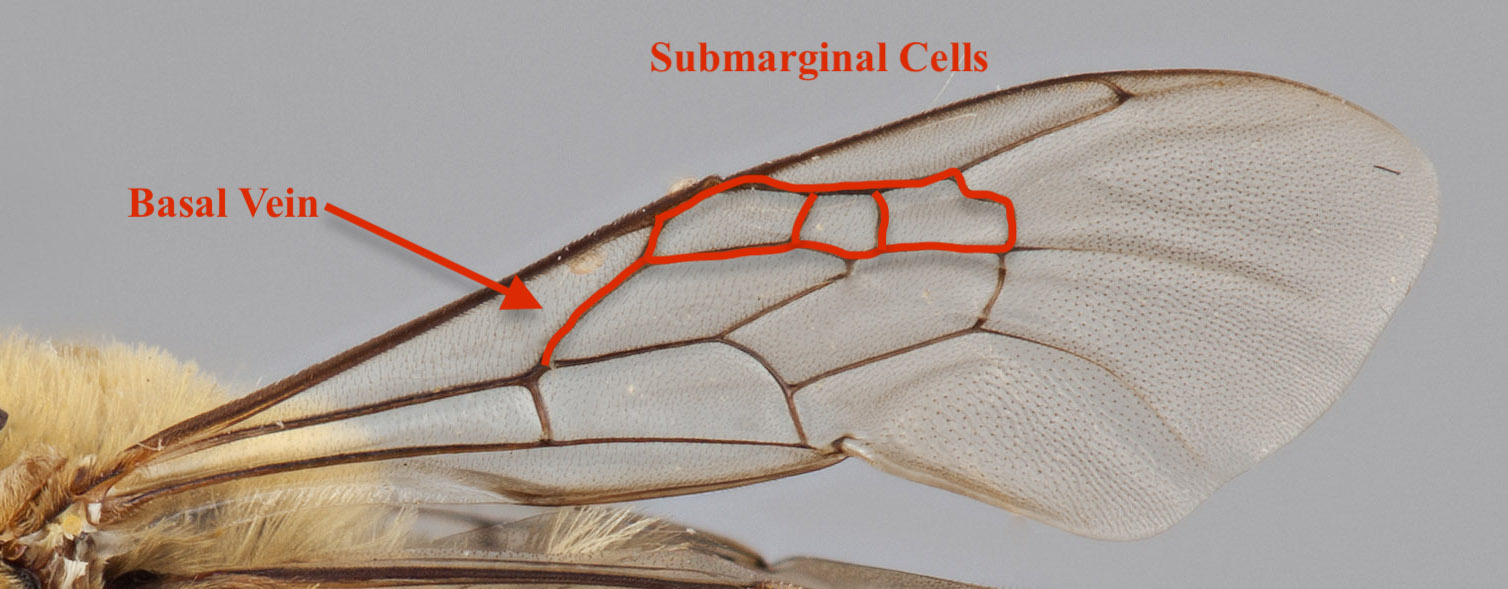
    Wing Cells

    Enclosed wing areas are used in taxonomy.

    Important morphology (VCE)

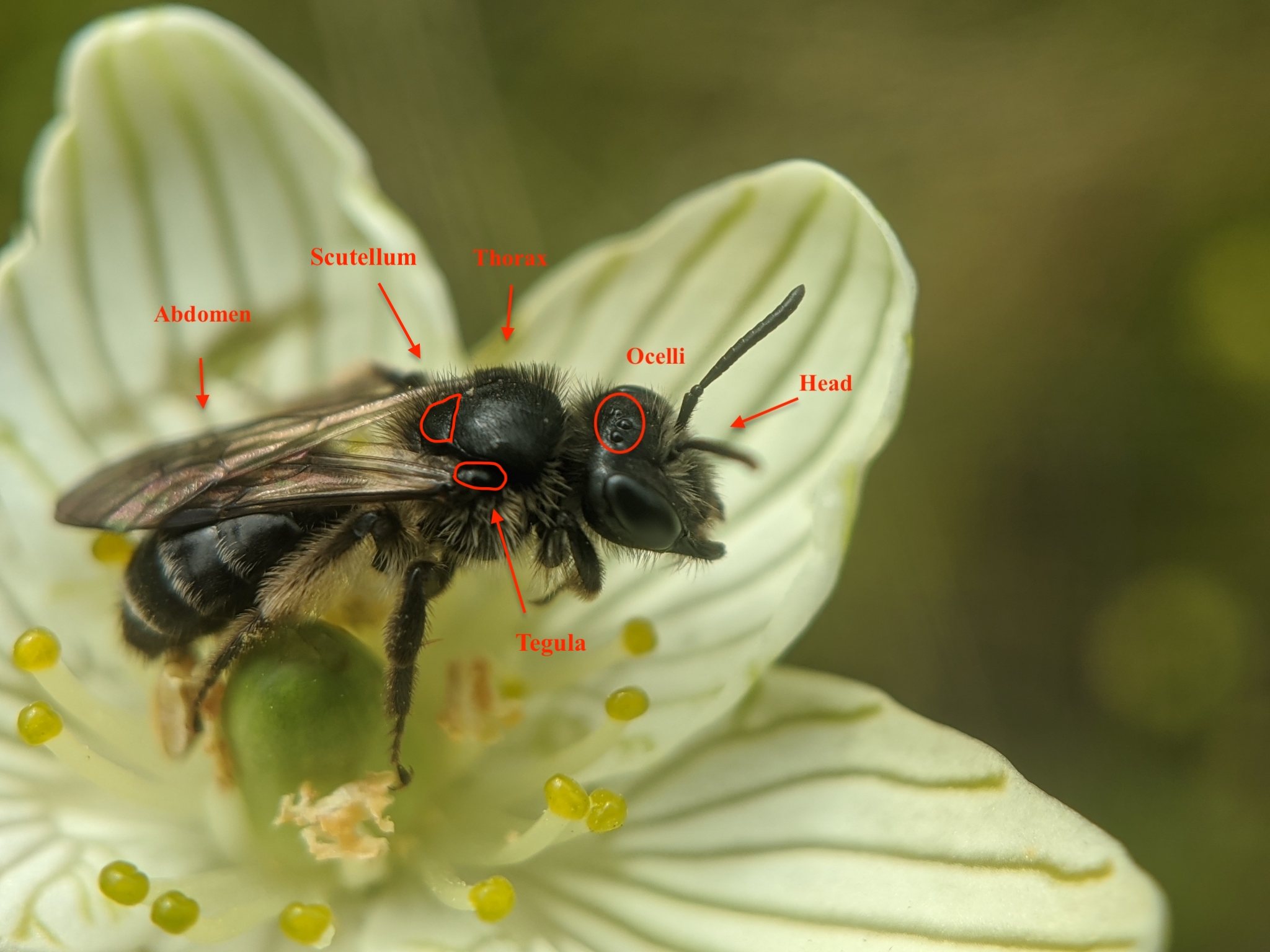
    General Body plan of a bee (Photo)

    https://val.vtecostudies.org/wp-content/uploads/2021/02/body-parts-2.jpeg

    Full Anatomy

    Labelled diagrams

    https://vtbugeyed.blogspot.com/2024/02/bee-body-parts.html

    Important morphology (VCE)

    Wing detail

    https://val.vtecostudies.org/wp-content/uploads/2021/02/Wing.jpg